
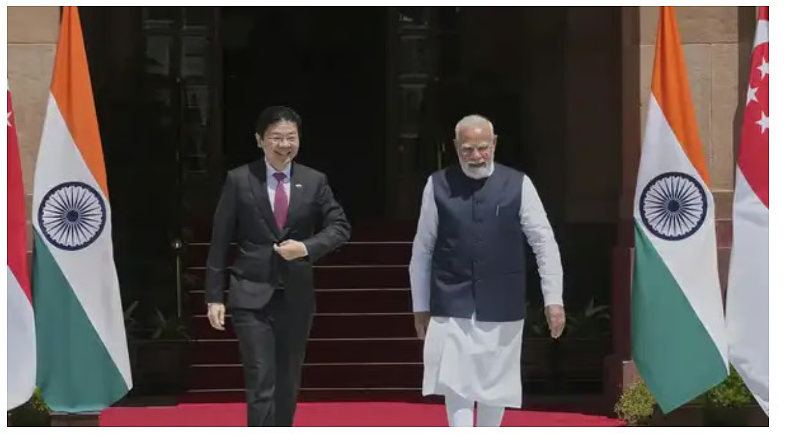
New Delhi: India and Singapore on Thursday outlined a comprehensive roadmap to deepen their strategic partnership, with Prime Minister Narendra Modi and Singaporean Prime Minister Lawrence Wong reaffirming their commitment to strengthen cooperation across multiple sectors. The talks focused on expanding bilateral trade, enhancing market access, and jointly addressing global disruptions in supply chains.
The two leaders agreed to scale up collaboration in advanced manufacturing, semiconductors, artificial intelligence, green shipping, skill development, civil nuclear energy, aviation, and defence—including the potential co-development of unmanned vessels. A total of five agreements were signed, covering aviation, skill development, green and digital shipping, space, and digital asset innovation to strengthen financial infrastructure.
Prime Minister Wong, who arrived in Delhi on a three-day official visit, underscored the importance of bilateral ties, calling the partnership “rooted in shared values, mutual respect, and trust.” He emphasized that Singapore and India can jointly strengthen resilience and contribute to regional stability.
Singapore remains India’s largest foreign investor, accounting for nearly one-fourth of total FDI inflows. As part of the collaboration, both sides inaugurated a container terminal at Nhava Sheva Port in Mumbai, where the Port of Singapore Authority has invested over USD 1 billion. A Memorandum of Understanding on green shipping will pave the way for the establishment of a Green and Digital Shipping Corridor (GDSC).
For the next phase of partnership, the two countries identified eight pillars of cooperation: economic ties, skills development, digitalization, sustainability, connectivity, healthcare and medicine, cultural exchanges, and defence and security cooperation. Modi stressed that the cooperation would expand beyond traditional areas to include new domains such as quantum computing, civil nuclear energy, and urban water management.
India and Singapore also agreed to jointly develop sustainable and next-generation industrial parks with advanced manufacturing capabilities. On defence cooperation, both countries will work on emerging areas such as automation, AI, unmanned vessels, and quantum technologies. Singapore also expressed appreciation for India’s interest in the Malacca Straits Patrol, highlighting maritime security as a shared concern.
In a joint statement, Modi thanked Singapore for its solidarity following the recent terror attack in Pahalgam, emphasizing that the fight against terrorism is a collective responsibility of nations. Both sides reaffirmed their commitment to peace and stability in the Indo-Pacific under India’s Act East Policy and ASEAN cooperation framework.
Preliminary discussions were also held on potential civil nuclear cooperation, including small modular reactors (SMRs), with both sides agreeing to form teams to take the talks forward. Officials further suggested that India could consider joining the ASEAN electricity grid in the future.
“Our relations go far beyond diplomacy. This is a partnership with purpose, rooted in shared values and guided by mutual interests,” Modi said, signaling the start of a new phase in India-Singapore relations.
Leave a Reply