
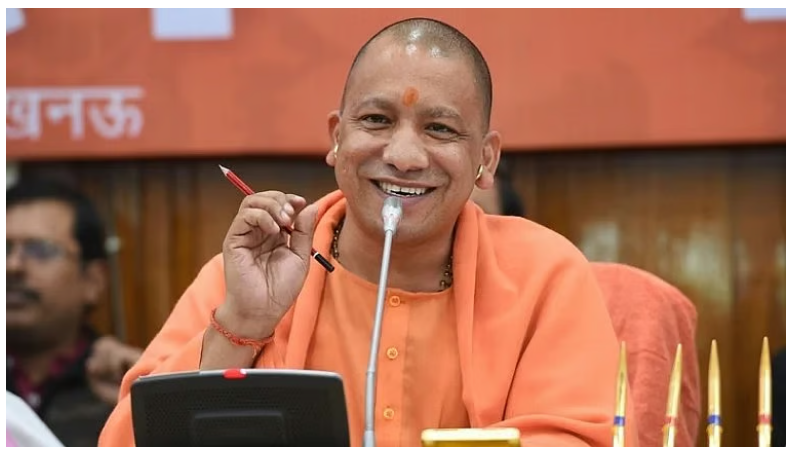
Lucknow: Uttar Pradesh’s school education has undergone a major transformation under Chief Minister Yogi Adityanath, addressing decades of neglect and systemic challenges.
Prior to 2017, many schools lacked basic facilities such as libraries, sports infrastructure, digital resources, and well-trained teachers, particularly in rural areas where children were deprived of even essential reading materials. Outdated supervision methods and poor teacher training further weakened literacy and learning outcomes.
After assuming office in 2017, CM Yogi initiated mission-mode reforms to revamp the state’s education system. Programs such as the Nipun Bharat Mission, PM Shri Vidyalaya, Vidya Samiksha Kendra, and the establishment of a state-of-the-art digital studio have provided schools with renewed energy and direction.
Today, schools serve as hubs for digital innovation, science, sports, and environmental responsibility. The government has set a target to achieve universal literacy and numeracy at the primary level by 2026-27. Already, 48,061 schools have been designated as ‘Nipun Vidyalayas’.
Teacher capacity has been strengthened, with 4.33 lakh teachers and Shikshamitras trained and 2.61 lakh teachers equipped with tablets. Innovative teaching tools such as math kits, TLM, Big Books, Sandarshika, and Shikshak Diaries have made classrooms more effective.
Technology-driven education has been a key focus. Currently, 25,790 schools have smart classrooms, 4,688 schools across 880 blocks feature ICT labs, and 1,129 PM Shri Vidyalayas include smart classes and digital libraries. A Rs 10 crore digital studio in Lucknow allows real-time monitoring through the Vidya Samiksha Kendra.
Supervision has also been made systematic, with ARPs in each block, SRGs in each district, and DIET mentors conducting regular collaborative school visits. Teacher cluster meetings and structured reviews ensure the sharing of best practices.
PM Shri Vidyalayas serve as model schools, offering libraries, sports infrastructure, project-based learning, and digital tools. Under the National Invention Campaign, 88,500 students have undertaken exposure visits, and in 2025-26, 150 meritorious students will visit premier institutes like IIMR and BARC.
Science parks are being developed across all 10 divisions. Environmental education is prioritized through eco-clubs, which have planted 27 lakh saplings under the ‘Ek Ped Maa Ke Naam’ initiative. Secondary schools are equipped with mathematics kits, exploratory boxes, TLM exhibitions, and remedial programs to enhance experiential learning.
Sports and co-curricular activities have also been promoted, with primary schools receiving Rs 5,000 and upper primary schools Rs 10,000 for sports equipment. Summer camps were organized in 45,614 upper primary and composite schools to encourage sports, arts, culture, and teamwork.
With these comprehensive reforms, Uttar Pradesh’s schools are emerging as engines of holistic education, preparing students for a Viksit Bharat and contributing to the state’s overall social and economic development.
Leave a Reply