
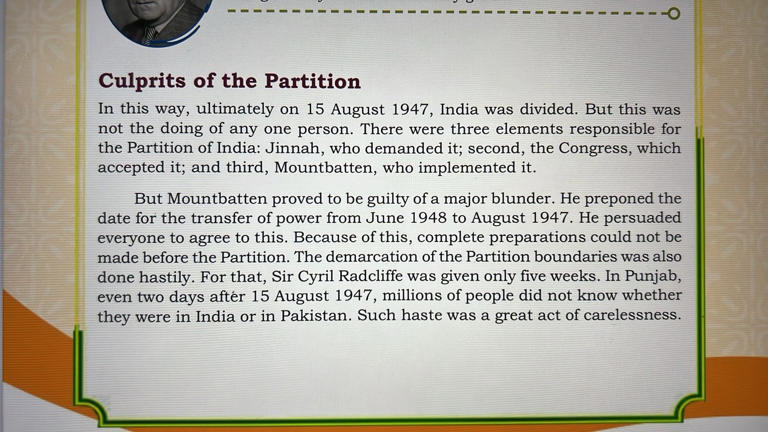
New Delhi: The National Council of Educational Research and Training (NCERT) has released a special module to mark Partition Horrors Remembrance Day, which has triggered controversy for partially blaming the Congress for India’s Partition. The module, aimed at school students from Classes 6–8 and 9–12, provides a broader perspective on the 1947 division, identifying three major players: Muhammad Ali Jinnah, who demanded Partition; the Congress, which accepted it; and Lord Mountbatten, who implemented it.
The module criticises Lord Mountbatten for what it calls a “major blunder” in advancing the date of the transfer of power from June 1948 to August 1947, despite inadequate preparation. It highlights that the hurried demarcation of boundaries by Sir Cyril Radcliffe, completed in just five weeks, caused chaos. In Punjab, even two days after independence, millions were unsure if they belonged to India or Pakistan.
Referencing Jinnah’s 1940 Lahore Resolution, the text notes his argument that Hindus and Muslims were fundamentally distinct, belonging to “two different villages, philosophy, social customs, and literature.” It also claims that the British initially proposed dominion status to preserve unity, but the Congress rejected this option.
The module also explores differing stances among Congress leaders. Sardar Vallabhbhai Patel reportedly believed Partition was necessary to prevent a civil war, while Mahatma Gandhi opposed Partition but refused to counter the Congress decision through violence. Jawaharlal Nehru and Patel ultimately accepted Partition, and Gandhi is said to have persuaded the Congress Working Committee on June 14, 1947, marking a critical shift in the party’s stance.
Highlighting the aftermath, NCERT calls Partition the largest displacement in human history, resulting in over six lakh deaths and leaving millions homeless. The module emphasises the atrocities faced by women and the human suffering caused by the man-made tragedy. It also points out that Partition turned Kashmir into a long-standing security issue, exploited by foreign powers for geopolitical leverage.
Leave a Reply