
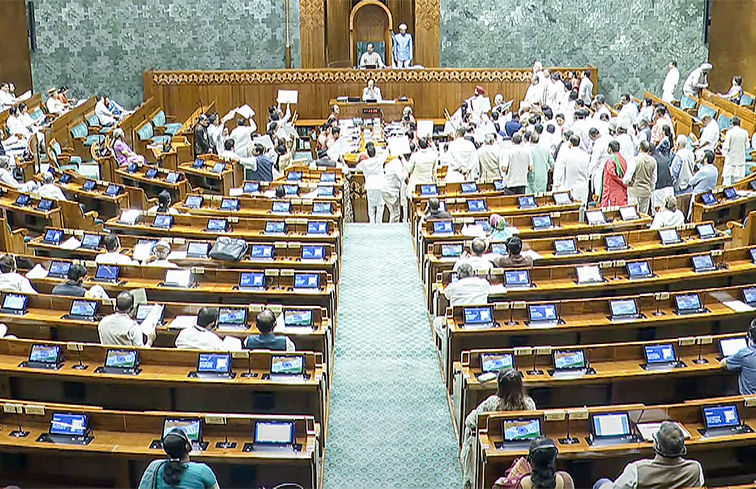
As India prepares to bid for the 2036 Olympic Games, the Lok Sabha passed two significant legislations on Monday – the National Sports Governance Bill, 2025 and the National Anti-Doping (Amendment) Bill, 2025 – amidst considerable disruption from opposition members.
Both Bills were approved via a voice vote, with the government proceeding despite the uproar in the House.
Sandhya Rai, who presided over the session, noted that the two legislations, introduced jointly by Union Youth Affairs and Sports Minister Mansukh Mandaviya, represent a crucial advancement in reforming India’s sports administration and aligning its anti-doping policies with international standards.
Their approval coincides with India’s ongoing “Continuous Dialogue” with the International Olympic Committee (IOC), which is laying the foundation for a formal bid to host the Games.
Mandaviya, who spoke briefly before the Bills were discussed, characterized the Sports Governance Bill as a long-awaited initiative to institutionalize transparency, athlete welfare, and ethical practices across sports federations.
“Sports is not a new subject. Reforms began in 2014 with the Khelo India movement. Now our athletes are performing globally, and this Bill ensures they receive the training and facilities they deserve,” he stated.
The Bill suggests the creation of a National Sports Board to regulate and recognize National Sports Federations (NSFs), including autonomous entities like the BCCI. It requires compliance with the Olympic Charter, the Paralympic Charter, and international best practices.
A National Sports Tribunal is proposed to resolve disputes related to athlete selection, federation elections, and governance matters, while a National Sports Election Panel will ensure fair elections within sports organizations.
The recent amendment to the National Anti-Doping Act, 2022, which was also approved via voice vote, aims to strengthen the autonomy of the National Anti-Doping Agency (NADA) and its appeals panel, responding to concerns from the World Anti-Doping Agency (WADA) regarding possible government interference.
These modifications are intended to align India’s anti-doping framework with the WADA Code and to uphold credibility in international sports arenas.
However, the legislative process was anything but smooth.
As BJP MP Ganesh Singh began to express his support for the Bills, opposition members surged into the Well of the House, chanting slogans that overwhelmed the proceedings. The content of these slogans and the comments from members were largely inaudible.
In spite of the turmoil, Mandaviya called on the Chair to approve both Bills simultaneously, which was swiftly accomplished. Among those who voiced support for the legislation was TDP MP Kesineni Sivanath from Vijayawada, Andhra Pradesh.
His endorsement highlighted the bipartisan acknowledgment of the necessity for reform, even as the opposition remained vocally resistant.
Additionally, the session featured Finance Minister Nirmala Sitharaman presenting a comprehensive Bill aimed at consolidating and amending the Income-tax Act, 1961, with the goal of simplifying tax terminology, enhancing digital compliance, and redefining undisclosed income to encompass virtual assets.
In a separate matter, Union Minister G Kishan Reddy introduced amendments to the Mines and Minerals (Development and Regulation) Act to enable state-supported overseas acquisitions of essential minerals like lithium and cobalt—resources crucial to India’s energy and defense sectors.
A series of standing committee reports were also presented to the House, addressing topics ranging from India’s Indian Ocean strategy and competition law in the digital economy to the execution of the National Education Policy in higher education.
Significantly, Darshan Singh Choudhary delivered the 362nd report from the Standing Committee on Education, Women, Children, Youth, and Sports, outlining the government’s response to previous recommendations.
In spite of the challenges, the day’s activities showcased a resolute legislative effort by the government to promote structural reforms in sports, finance, and resource management – all of which have consequences for India’s international reputation and domestic progress.
Leave a Reply