
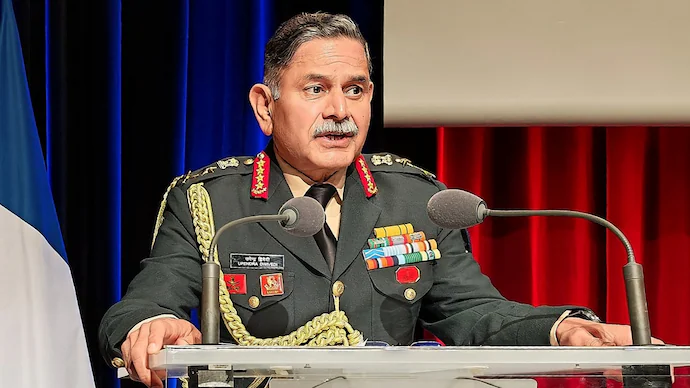
Operation Sindoor was a unique mission, distinct from traditional operations, as the Army faced uncertainty regarding the enemy’s subsequent actions, resembling a chess match. Nevertheless, India achieved a significant victory, as stated by Chief of Army Staff (COAS) General Upendra Dwivedi, who also recognized the inherent risks of this strategy.
“In Operation Sindoor, we engaged in a game of chess… We were unaware of the enemy’s forthcoming moves, just as they were uncertain of ours. This situation is referred to as the greyzone. Greyzone signifies that we are not conducting standard operations. What we are executing is nearly equivalent to a conventional operation… We were making strategic moves, while the enemy was also responding with their own moves,” remarked the Army chief.
During an event at IIT Madras, he further stated, “In some instances, we were delivering checkmate, while in others, we were advancing for the kill, accepting the risk of potential losses, but that is the essence of life.”
The anti-terror operation, initiated on May 7 in response to the Pahalgam terrorist attack that resulted in the deaths of 26 civilians by Pakistan-based militants in Jammu and Kashmir, was propelled by political determination and strategic clarity from the government, the Army chief noted. He praised the decision to provide the Army with a ‘free hand’ during high-level discussions with Prime Minister Narendra Modi and the Defence Minister.
“On April 23rd, we convened. This was the first occasion when RM (Defence Minister Rajnath Singh) declared, ‘enough is enough.’ All three chiefs unanimously agreed that action was necessary. The free hand was granted, ‘you determine the course of action.’ This level of confidence, political guidance, and clarity was unprecedented,” Dwivedi remarked at the event.
He criticized Pakistan’s narrative management, which presents itself as the victor in the ongoing conflict, highlighting the government’s choice to promote its Army chief, Asim Munir, to the rank of five-star general and field marshal.
“The narrative management system is something we recognize significantly because victory is always in our thoughts. If you were to ask a Pakistani whether they lost or won, they would respond, ‘The Army chief has been promoted to Field Marshal. We must have won, which is why he has attained this rank,'” stated the Army Chief.
Regarding the mission’s name, ‘Operation Sindoor,’ General Dwivedi remarked that it was a unifying force for the nation.
“It is crucial how a simple name like Op Sindoor can connect the entire nation… This is what galvanized the whole country… That is why the entire nation was questioning why we had halted. That inquiry has been thoroughly addressed,” he continued.
Operation Sindoor, a targeted military initiative by India, involved precise strikes against terrorist infrastructure and camps located in Pakistan and Pakistan-occupied Kashmir. The Indian armed forces, operating with full governmental support, executed a series of air and missile strikes on nine designated targets.
While India asserted that the strikes were focused, measured, and did not escalate tensions, Pakistan retaliated with drone and missile attacks, which were effectively countered by India’s air defense systems.
The mission is broadly regarded as a triumph for India, both in military terms and in psychological impact. Analysts suggest that the operation showcased India’s ability for high-precision, coordinated military action, successfully dismantling terrorist infrastructure and re-establishing deterrence against state-sponsored cross-border terrorism.
Leave a Reply