
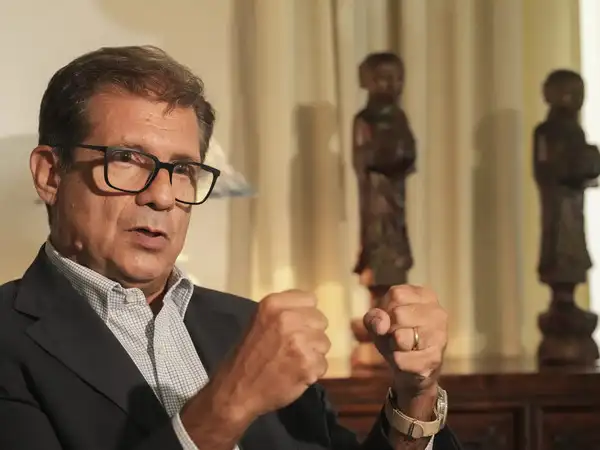
India plays a “certainly crucial” role in the transnational IMEC project due to its status as a significant market and producer. The initiative focuses on the trade of goods, energy, and data connectivity, with New Delhi being a “protagonist in all three sectors,” according to a senior Italian diplomat.
Described as a groundbreaking initiative, the India-Middle East-Europe Economic Corridor (IMEC) aims to establish extensive road, rail, and shipping networks connecting Saudi Arabia, India, the US, and Europe, with the goal of fostering integration among Asia, the Middle East, and the West.
Italy’s special envoy for IMEC, Francesco Talo’, remarked that the ambitious project was launched with a “lot of hope” and emphasized the necessity of such initiatives, particularly in times of volatility and uncertainty caused by global security challenges.
Talo’, an experienced diplomat, recently visited India to participate in a meeting with representatives from countries involved in the IMEC initiative, which was solidified during the G20 Summit in Delhi in September 2023.
“India is certainly crucial, as it represents a vast market and a major producer. Therefore, it holds significant importance in both aspects. Furthermore, IMEC should be viewed as a network of connectivity rather than merely a corridor, as it encompasses more complexity than a simple point-to-point link,” he stated in the interview conducted at the Italian Embassy.
This project is fundamentally about trade, including the exchange of goods, as well as energy and data. He reiterated, “India is a protagonist in all three sectors.”
Thus, it is clear that “you (India) are important,” increasingly so as an industrial nation, a recipient market, and a technology hub. Consequently, the connectivity of data and digital connections originating from India are of great significance, the envoy emphasized.
“We are establishing a connection between India and Europe. Together, we can truly become the key players in this initiative. There is a project known as Blue Raman, which aims to link Mumbai with the Italian port of Genoa in the Mediterranean, and subsequently extend connectivity throughout Europe. This is vital, as data serves as the fuel of the 21st century,” Talo’ remarked.
He highlighted the essential nature of digital connectivity in addition to physical links, which will support data centers and enhance “the potential and power of our artificial intelligence, technologies, and overall economy.”
Furthermore, he mentioned that the trade of goods between India and the European Union is expected to “double in the next decade” due to this initiative, although he did not provide further details. He also noted that energy remains crucial for the digital economy, as data centers require significant energy resources, the envoy pointed out.
During his trip to New Delhi, Talo’ engaged with the deputy National Security Advisor and several other high-ranking officials from the central government.
“I have conducted meetings with members of the administration, particularly those in the National Security Council and the Ministry of External Affairs. I plan to meet additional officials today (August 6) to gain a deeper understanding of the significance of our partnership with India,” he stated.
Talo’ mentioned that discussions took place regarding India’s potential to increase its production of hydrogen, particularly green hydrogen, not only for domestic use but also for export.
“This is particularly relevant for the Gulf countries, which possess abundant energy resources and favorable conditions for solar and wind energy production. Conversely, Europe is in need of energy, as we do not generate enough. Thus, there are shared interests in this area: energy, digital connectivity, and overall connectivity,” the envoy emphasized.
Additionally, he noted the significance of the “first meeting” among the special envoys of IMEC taking place in this very city, the diplomat remarked.
“I was present when the initiative was launched in September 2023. I was alongside my Prime Minister Giorgia Meloni. We shared a clear vision of a significant opportunity for our nations and our mutual interests,” Talo’ remarked, adding that IMEC was initiated with a “great deal of hope” and was closely tied to the aspiration of achieving substantial political and economic outcomes.
He emphasized that this is indeed the time to transition from a phase characterized by conferences, interviews, and some public events to a “more tangible phase of action.”
In September 2023, an agreement was reached among India, Saudi Arabia, the European Union, the United Arab Emirates (UAE), the United States, and several other G20 partners regarding the corridor.
During the discussion, he also explained why Italy is promoting its coastal city of Trieste as a “potential main hub” for this corridor.
Regarding France’s proposal to position Marseille as a possible terminal on this corridor, Talo’ stated, “I believe we need multiple terminals. In fact, I understand that India may have several ports.”
The EU signatories Italy, France, and Germany are collaborators in this transnational connectivity initiative, and the envoy mentioned that Rome is approaching this with the ethos of “Team Europe.”
Talo’ indicated that Italian Foreign Minister Antonio Tajani intends to organize an IMEC-related meeting in Trieste, “by the end of this year.”
“This is not a formal gathering with all the ministers. It is primarily aimed at showcasing Trieste as an excellent opportunity, as an ideal hub for IMEC. The meeting will cater to the business community and some ministers as well,” he noted.
When asked if External Affairs Minister S Jaishankar would be invited to the meeting, he replied, “Certainly, the Indian minister would be the key participant…, but it will not be a formal meeting.”
Leave a Reply