
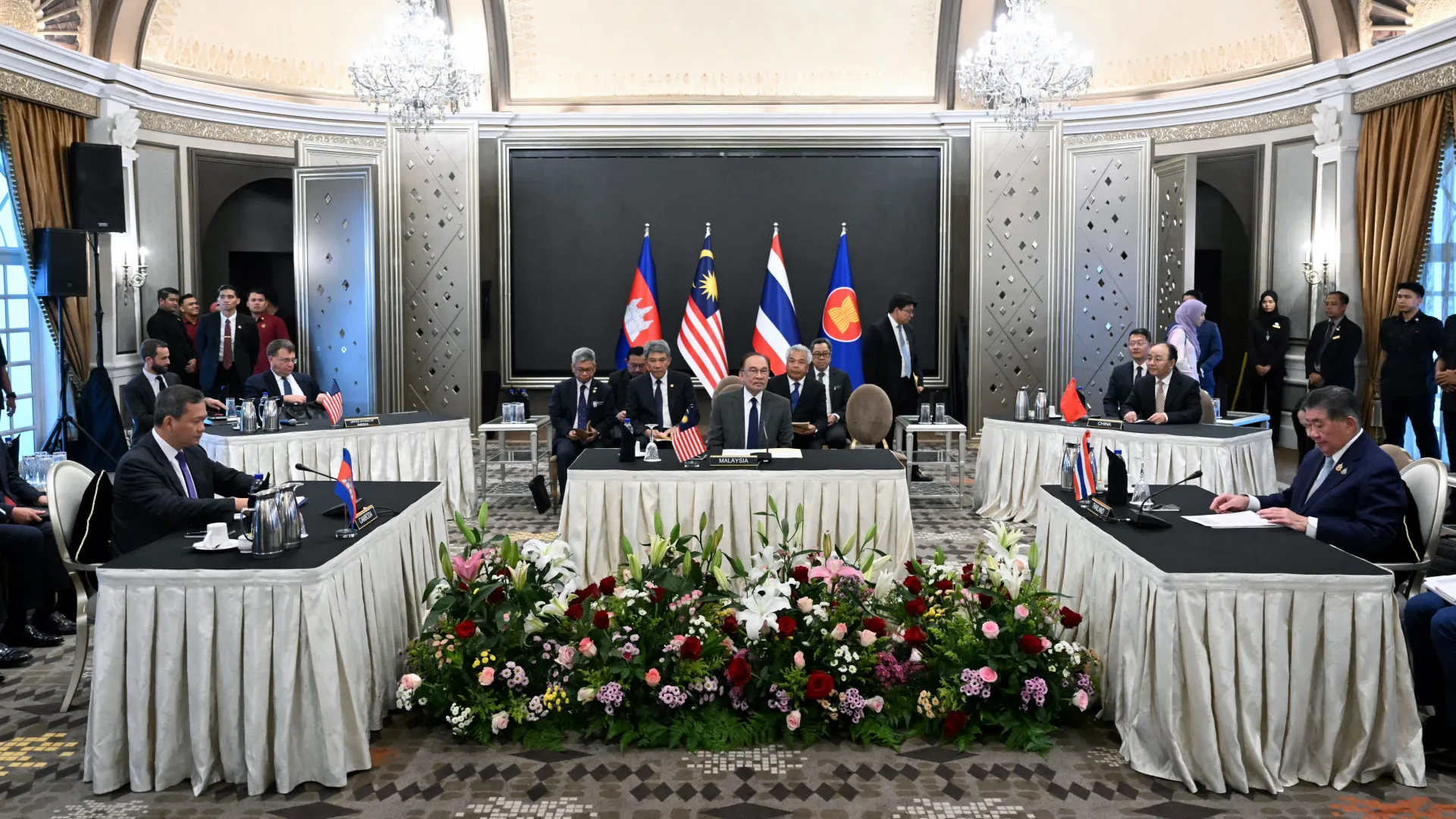
Putrajaya: Cambodia and Thailand have reached an agreement for an “immediate and unconditional ceasefire” effective at midnight local time (12 p.m. Monday), as stated by Malaysian Prime Minister Anwar Ibrahim on Monday. This announcement follows several days of violent clashes along the disputed border between the two Southeast Asian nations, according to Malaysia’s state media.
The ceasefire agreement was established after discussions between Cambodian Prime Minister Hun Manet and acting Thai Prime Minister Phumtham Wechayachai at the Prime Minister’s official residence in Putrajaya, located just south of Kuala Lumpur, as reported by the Bernama news agency.
As per Malaysia, which facilitated the negotiations, both parties will convene a meeting of regional commanders from the Cambodian and Thai armed forces on July 29 to discuss the ceasefire’s implementation.
The recent border violence has resulted in at least 35 fatalities and over 200 injuries, according to reports from officials in Thailand and Cambodia. Both countries have accused one another of instigating the latest wave of violence. “The border dispute has persisted for decades,” CNN noted.
In spite of ongoing allegations of renewed artillery fire in disputed regions, leaders from Thailand and Cambodia convened in Malaysia today to seek a resolution to the deadly conflict, as reported by Al Jazeera. The meeting was attended by Thailand’s acting Prime Minister Phumtham Wechayachai and Cambodian Prime Minister Hun Manet.
Malaysia, which is currently presiding over the Association of Southeast Asian Nations (ASEAN), has offered to mediate the ongoing crisis, which has resulted in over 30 deaths in recent days, including civilian casualties from both nations.
US Ambassador to Malaysia Edgard Kagan and Chinese Ambassador to Malaysia Ouyang Yujing were also present at the meeting, according to Bernama. The US co-organized the meeting, while China participated as an observer.
PM Hun Manet and Acting PM Phumtham Wechayachai have conveyed their positions and readiness for an immediate ceasefire and a return to normalcy, as stated in a joint press release from the special meeting issued by Malaysia’s foreign ministry. The President of the United States, Donald J. Trump, has reached out to the leaders of both nations, encouraging them to seek a peaceful resolution to the ongoing situation, according to the statement.
The Chinese government has maintained close communication with Cambodia, Thailand, Malaysia, and other relevant nations to actively foster dialogue, ceasefire, and the restoration of peace, as stated by the Malaysian foreign ministry.
“The involvement and cooperation of all parties highlight a collective dedication to peace, dialogue, and regional stability,” the statement noted.
Cambodia and Thailand have come to a mutual agreement for “an immediate and unconditional ceasefire, effective from 24:00 hours (local time) on 28 July 2025.” “This represents a crucial initial step towards de-escalation and the re-establishment of peace and security,” the joint press release from the governments of Malaysia, Cambodia, and Thailand indicated.
The two nations will hold an informal meeting of regional commanders (Regional Military 1 and 2 from Thailand and Regional Military 4 and 5 from Cambodia) at 07:00 hours on 29 July 2025, followed by a meeting with the Defence Attaches led by the ASEAN Chair, contingent upon mutual agreement. Additionally, both countries have agreed to hold a meeting of the General Border Committee (GBC) on 4 August 2025, which will be hosted by Cambodia, as stated in the joint press release.
As the current Chair of ASEAN, Malaysia has expressed its readiness to coordinate an observer team to verify and ensure the implementation of the agreements. Malaysia will also engage with other ASEAN Member States to participate in the observation efforts, demonstrating a regional commitment to fostering peace on the ground.
Both parties have also consented to resume direct communications between their Prime Ministers, Foreign Ministers, and Defence Ministers.
The Foreign Ministers and Defence Ministers of Malaysia, Cambodia, and Thailand have been tasked with creating a comprehensive mechanism for the implementation, verification, and reporting of the ceasefire. This mechanism will act as a basis for ongoing peace and accountability.
The situation deteriorated after both parties exchanged artillery fire along contested areas of their 817 km shared border, as reported by Al Jazeera. Last week, Malaysian Prime Minister Anwar Ibrahim suggested a ceasefire and called on both countries to settle their disputes through diplomatic means.
Despite early indications of progress following US President Donald Trump’s appeals to both leaders for a ceasefire, hostilities resumed within hours. Cambodia expressed its support for Trump’s request, while Thailand indicated that peace negotiations could not advance as long as Cambodian forces were reportedly targeting Thai civilians, a claim that Phnom Penh denied.
Cambodia’s Ministry of National Defence accused Thailand of conducting artillery and ground assaults near various border sites, including historic temple locations, according to Al Jazeera. A spokesperson from the ministry reported damage to ancient temple complexes due to shelling.
In response, the Thai military claimed that Cambodian troops had fired into residential areas and were preparing long-range rocket launchers for additional attacks. The protracted border dispute mainly centers on sovereignty claims over historic sites, especially the ancient Hindu temples of Ta Moan Thom and Preah Vihear, as stated by Al Jazeera.
Although the International Court of Justice ruled in 1962 that Preah Vihear belongs to Cambodia, tensions reignited in 2008 when Cambodia sought UNESCO World Heritage designation for the temple, resulting in years of intermittent clashes. Given the ongoing tensions, the discussions taking place in Kuala Lumpur on Monday are regarded as a vital move to avert any further escalation.
Leave a Reply