
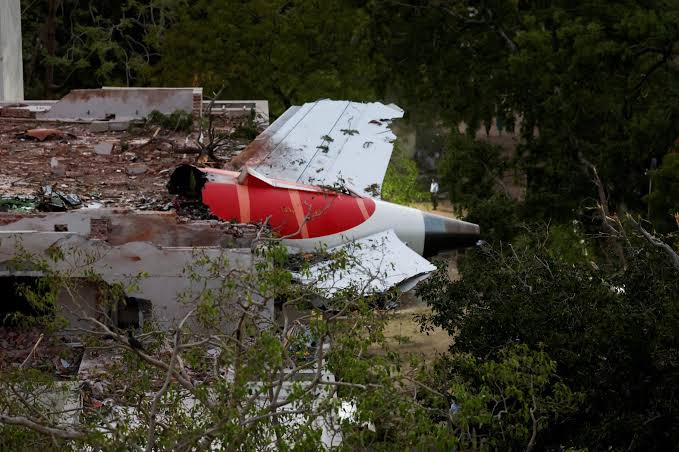
The initial report regarding the investigation into the Air India Dreamliner crash in Ahmedabad on June 12 has been made public, revealing a significant finding that confirms earlier suspicions – both engines of the aircraft failed mid-flight just seconds after take-off.
The report from the Aircraft Accident Investigation Bureau concerning the Boeing Dreamliner 787-8 crash, which resulted in the deaths of at least 270 individuals, including 241 of the 242 passengers on board, indicates that the fuel cutoff switches, responsible for regulating fuel flow to the engines, shifted from ‘RUN’ to ‘CUTOFF’ in quick succession, within a second of each other.
Notably, the cockpit voice recording captures one pilot questioning, “Why did you cut off?” to which the other pilot responds, “I didn’t.”

The transition of the switches to ‘CUTOFF’, which deprived the engines of fuel, is anticipated to be a primary focus of the ongoing investigation.
The report, released shortly after 1 am on Saturday, highlights that footage of the incident shows the Ram Air Turbine (RAT) being deployed, signifying a complete loss of power and thrust in the aircraft.
“CCTV footage obtained from the airport indicates that the Ram Air Turbine (RAT) was deployed during the initial climb right after take-off. There was no notable bird activity detected in the area surrounding the flight path. The aircraft began to descend before it reached the airport perimeter wall,” the report elaborates.
Data retrieved from the Enhanced Airborne Flight Recorder (EAFR), commonly referred to as the black box, disclosed that both switches were returned to the ‘RUN’ position, and while Engine 1 exhibited signs of recovery, Engine 2 failed to respond.

Engine 1’s core deceleration halted, reversed, and began to recover. Engine 2 managed to relight but failed to stop the core speed deceleration, repeatedly reintroducing fuel to boost core speed acceleration and recovery,” the AAIB stated in its report.
Flap Setting Normal
The aircraft was in the air for just 32 seconds, covering a mere 0.9 nautical miles before crashing into the BJ Medical College Hostel near the airport. The incident took place at 1:39 PM.
According to the report, while the thrust levers were located near the idle position, black box data indicated they remained in the forward position until impact. Both fuel control switches were also found in the ‘RUN’ position.
Addressing a significant area of speculation, the report confirmed that the flap setting (at five degrees) and the landing gear lever position (DOWN) were appropriate for take-off.

‘No Immediate Evidence Of Sabotage’
Another important finding by the AAIB is the absence of immediate evidence suggesting sabotage.
The investigating agency pointed out that the Federal Aviation Authority had issued a warning in 2018 concerning the fuel control switches.
“The FAA released Special Airworthiness Information Bulletin (SAIB) No. NM-18-33 on December 17, 2018, regarding the possible disengagement of the fuel control switch locking feature. This bulletin was prompted by reports from operators of Model 737 aircraft indicating that the fuel control switches were installed without the locking feature engaged. The airworthiness issue was not deemed serious enough to necessitate an airworthiness directive (AD) by the FAA,” the report noted.
It was mentioned that Air India had not performed the inspections, although they were not required.
According to information provided by Air India, the recommended inspections were not performed because the SAIB was advisory rather than mandatory. An examination of maintenance records indicated that the throttle control module on VT-ANB was replaced in both 2019 and 2023. However, the replacement was not associated with the fuel control switch. Since 2023, no defects related to the fuel control switch have been reported on VT-ANB,” it stated. Other Considerations? The report indicated that there were no weather-related problems at the time of the crash. The weather was clear, visibility was good, and wind conditions were mild. The pilots were also confirmed to be medically fit, well-rested, and possessed sufficient experience operating that specific aircraft.